Prologue: A May Without flomo
For the entire month of May, I did not write a single flomo note. I barely posted to my feed either.
This was not laziness. It was a conscious decision. I had already decided on April 30 that I would stop. The reason is simple: I no longer felt I needed it. Or more accurately — could it have a better form? I want to use my own product. It is not perfect yet, but I want to fully think through and ship the thing I have in my head. The remaining steps are few. It is close.
But once flomo was off, May turned into a strange month: without the daily nudge to “write one down,” I handed myself entirely over to the experience itself. So this piece does not grow from fragmented notes. It is scooped out of the whole month’s flow. Looking back, the month was much heavier than I thought — on the surface it was relaxed, detoxing, full of play; underneath, it was a complete experiment about who I actually am.
If I had to put May in one line: it was an experiment in intentional disconnection. Disconnecting from the recording tool someone else designed for me (flomo), disconnecting from Shenzhen and that default script of “how a life should be lived,” and placing myself in a high-uncertainty environment where my body was always present and I could meet strangers at any moment — to see, when the external frame is removed, what I am drawn to, when I light up, and when I go hollow.
The rest of this piece pulls apart the experiment, layer by layer.
I. Geography and Mood: Luang Prabang → Vang Vieng → Vientiane
Luang Prabang: a kind of small town the world still has
At the end of April I was in Luang Prabang. A beautiful, very quiet small town. We spent a lot of time in cafés, watched the early-morning market, and watched the alms-giving — which you have to get up very early to catch.
The alms-giving left a deep impression. Before the sky was fully bright, monks walked in a line and locals knelt by the road to place food in the bowls — the whole thing quiet, slow, repeated for who knows how many centuries. In that moment I had a very plain feeling: the world still has small towns this different, ways of living this different. It does not shout, does not chase, does not prove anything to you. It just exists, so self-consistent that it makes you slightly disoriented.
Later I realized Luang Prabang was a great opening to this experiment — it pulled me out of the Shenzhen tempo first, letting me see that slow can stand on its own, and slow without apology.
Vang Vieng: the happiest days of my entire May
Early May I arrived in Vang Vieng. The 1st, 2nd, 3rd, 4th, 5th — nearly all of it was play. Looking back, those were the happiest days.
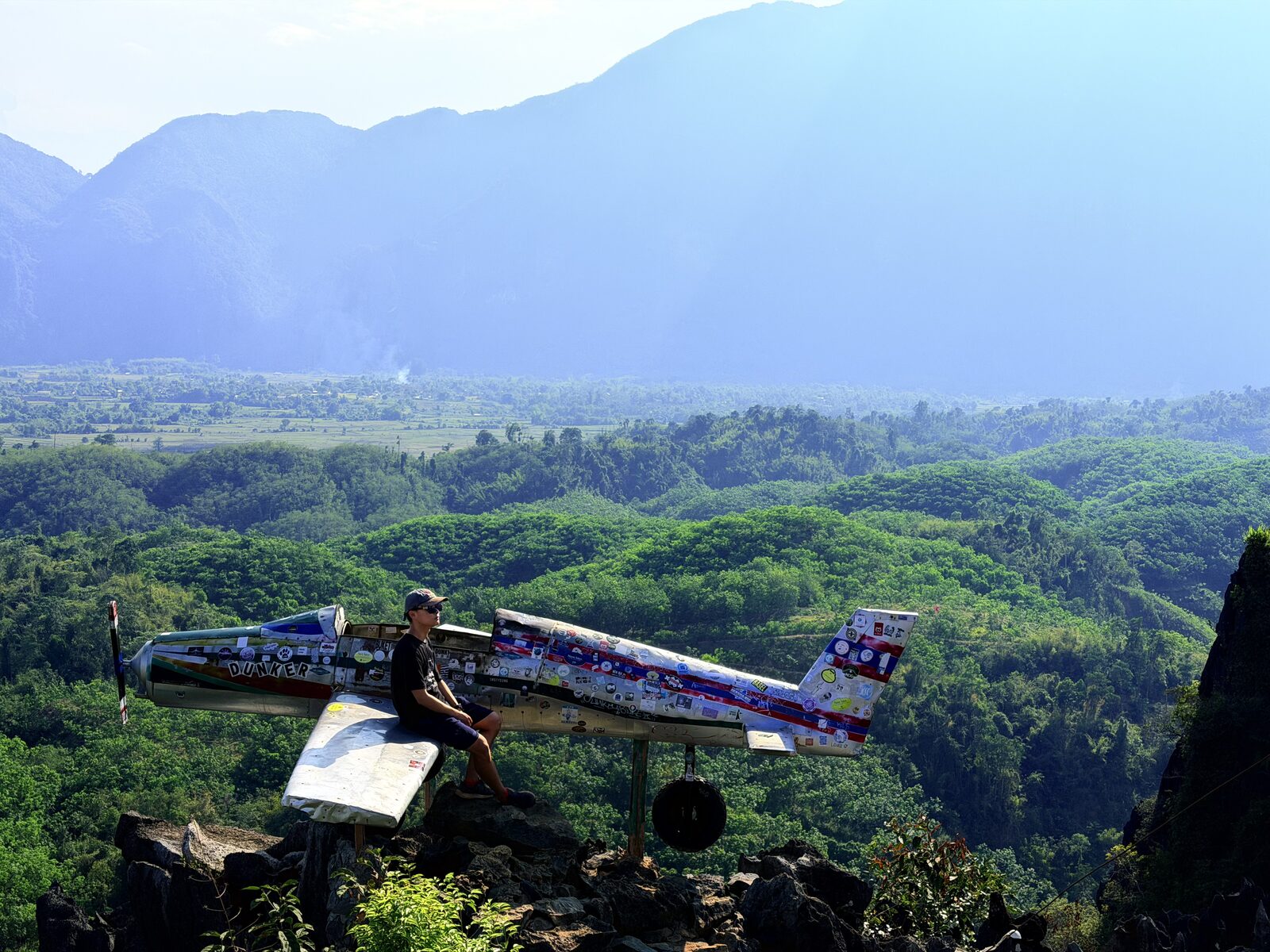
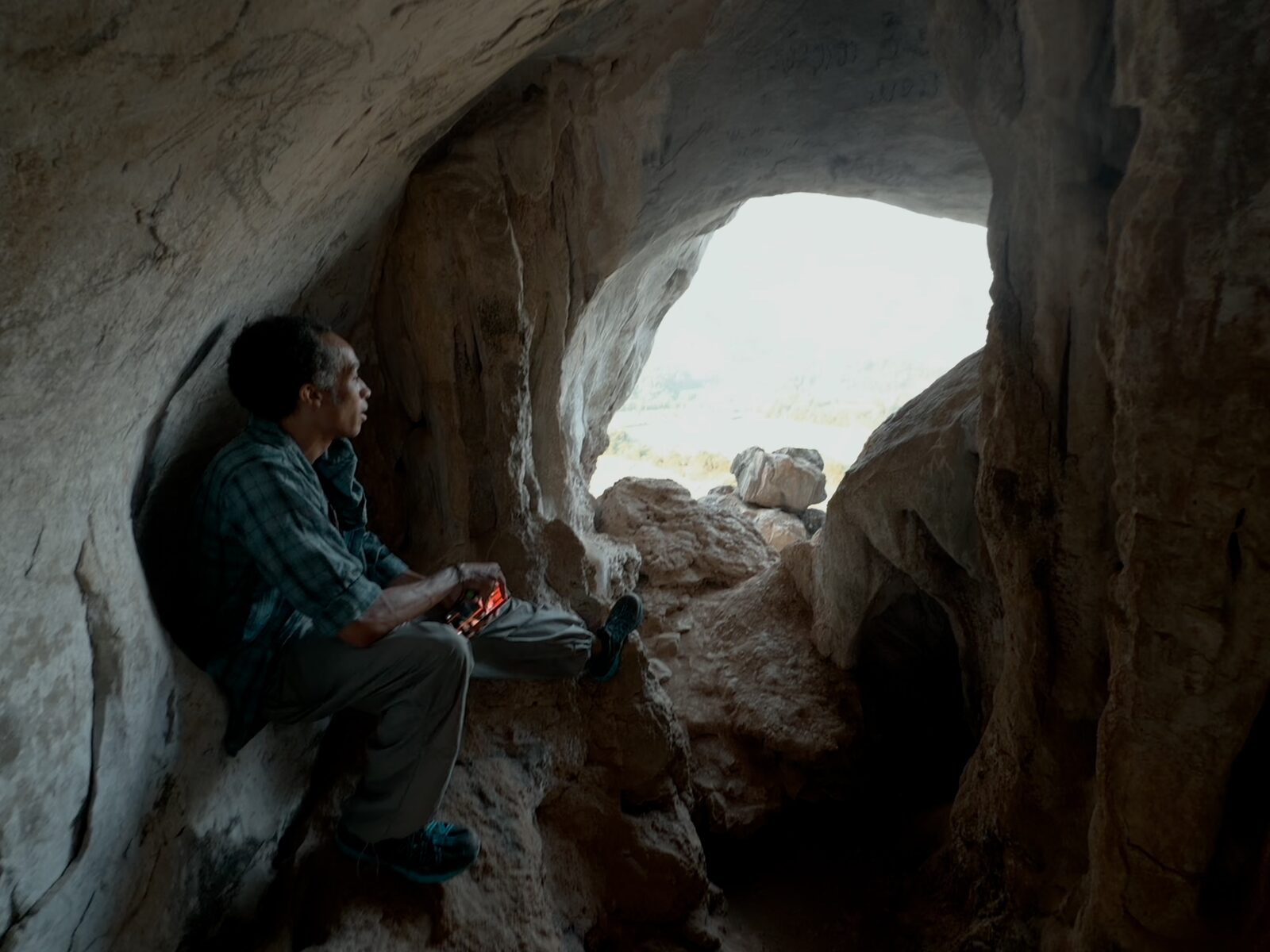
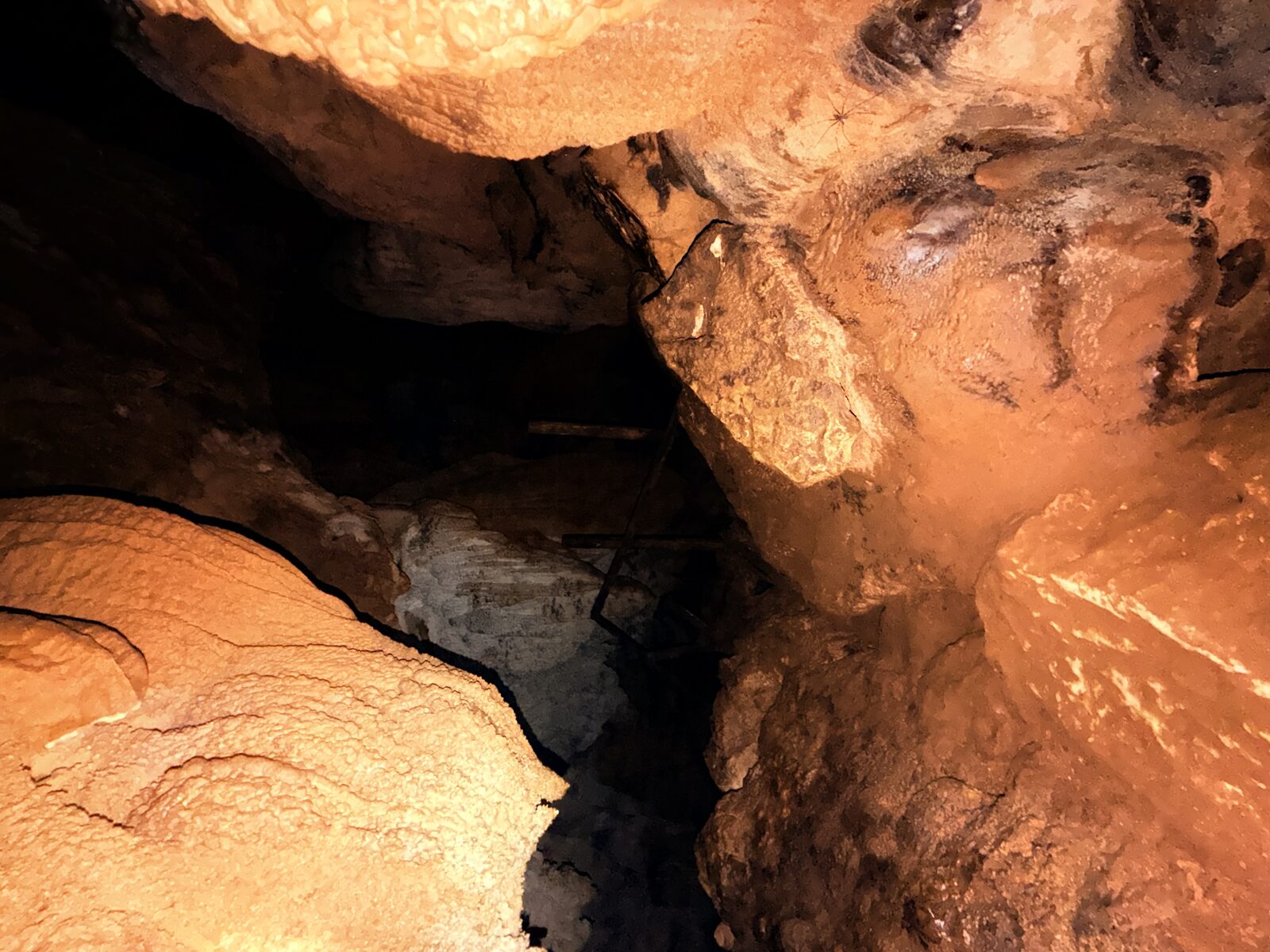
Vang Vieng is a place where you can go wild. You can cliff jump, crawl into caves, ride a motorbike everywhere, surrounded by mountains and rivers and unknowns. I am addicted to adventure. We went into one cave — pitch black, very deep. Bats everywhere, total darkness around you, you have to keep your flashlight or phone light on, and you have to walk a long way in, about an hour. It was really, really deep.
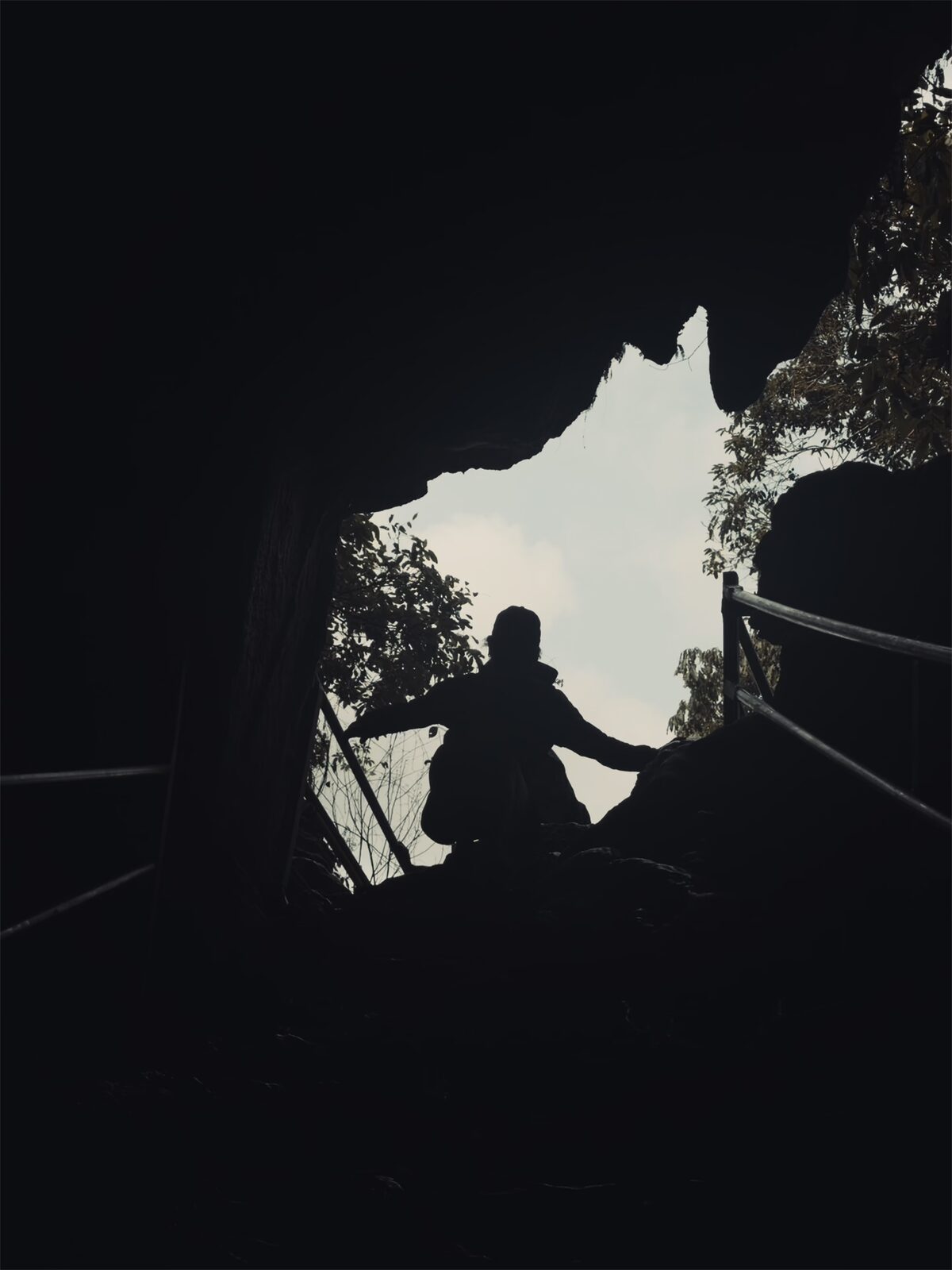
The cave later became a key for understanding myself. The first time I went with Sasha. She got partway in and would not go further, kept saying “let’s not go deeper” — she was a bit out of it that day, her rational analysis was off, so she turned back. The second time I went with a hilarious Black American guy. I had crashed my motorbike and hurt my leg, so to avoid infecting the wound I did not go into the water, but I could still walk, so I went deeper with him.
The group I met in Vang Vieng is the other half of why those days glowed. Sasha, some old friends, a friend from Shanghai, and that Black American guy — emotionally extremely steady, very inward, more reflective than reactive, almost never visibly emotional. His girlfriend was the opposite — outgoing, from Tianjin. He always wanted to come along, we all loved adventure. I later thought, a love of adventure seems like a trait many Americans have. But relatively speaking, I am the one truly addicted to adventure — all of us outdoors together, feeling the pull of risk.
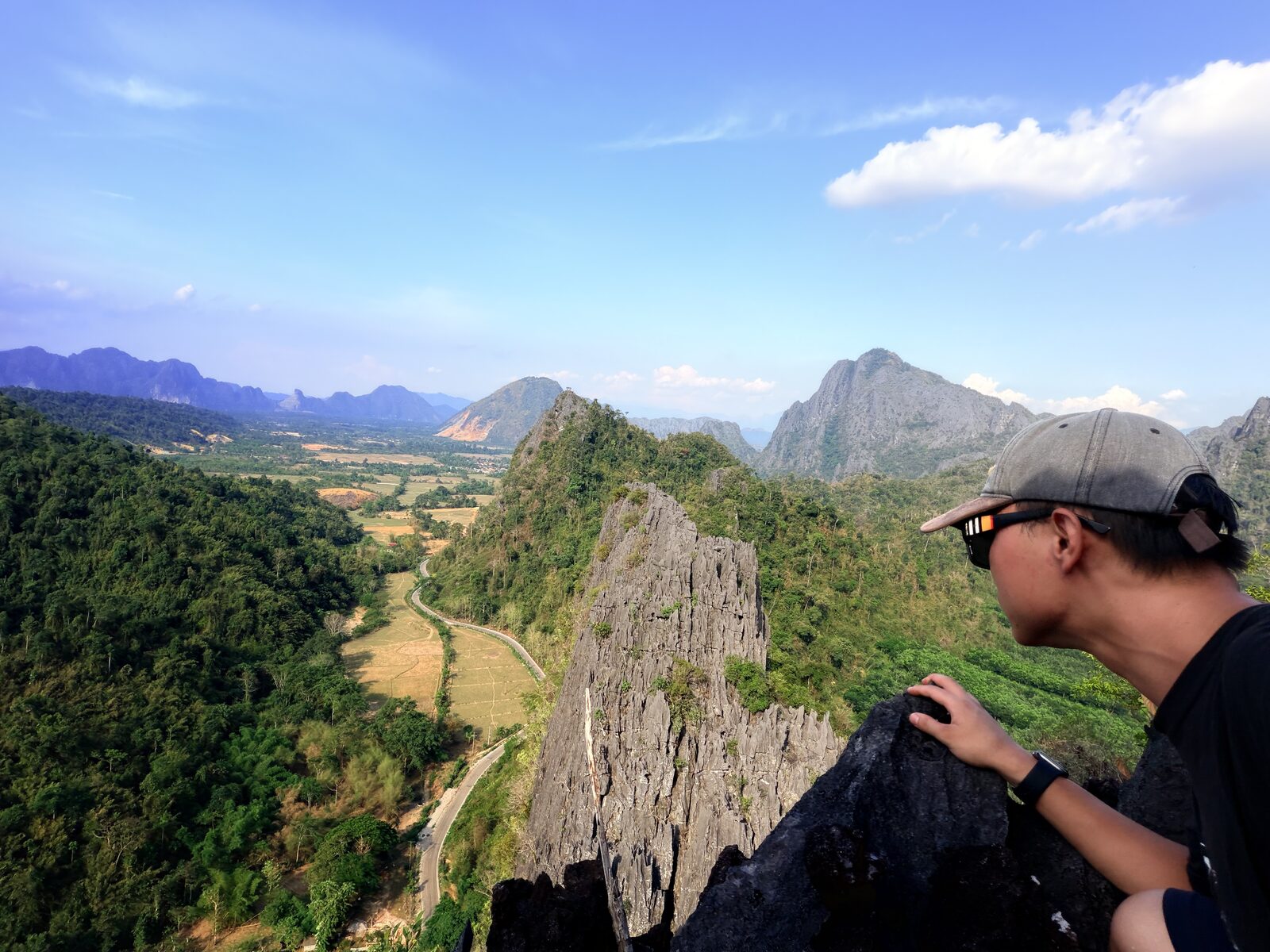
When it was time to leave, I felt a small reluctance. That “reluctance” would become an important clue later on.
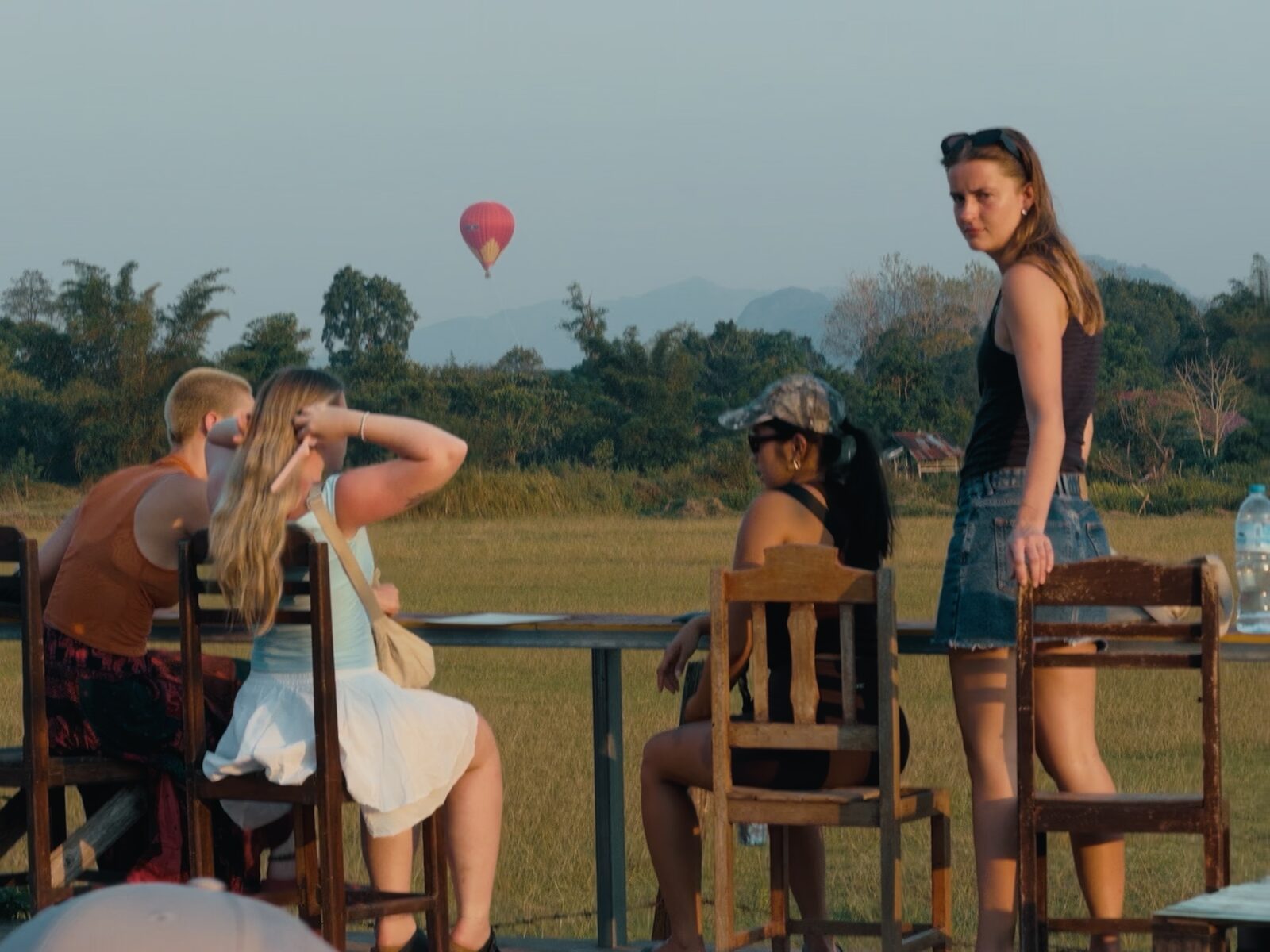
Vientiane: From the High of the Water Festival to the Cold of the Next Day
After that came Vientiane.
I had always had a good feeling about Vientiane. The first time I passed through, the city was right in the middle of the water festival. The whole place suddenly came alive — extremely outward, extremely energetic. It was as if every single person was in it, and loving it. The boundary between people thinned out, everyone was friendly, everyone was happy, everyone was playing without holding back. That visit taught me something big: a city can be this collectively, unreservedly joyful.
But the night the water festival ended, the city went cold. I stood in the street with an overwhelming sense of contrast. Once the celebration was gone in a flash, I realized something: environment affects me a lot more than I thought. I was so unable to sit still that I had to go out for a walk, even if there was not a single person on the street. I really cannot stay indoors.
I kept turning this over later. I am an “I” on the Myers-Briggs scale, but my energy logic is not the simple “introvert = doesn’t need outside stimulation.” Exactly the opposite — once the high-density external stimulation of the water festival was withdrawn, I felt an energy deficit. Which means my dependence on environment, on the external field, runs deeper than I had assumed.
I ended up staying in Vientiane for over a month. I think I went to most of the places worth going — every corner, every spot, every story. I went to a bar two or three times a week, danced, often danced until dawn. I love that feeling, I cannot quite say why, but it is a very real other side of me. And yet I cannot tell — between the me dancing in a club and the me reading quietly in a café, which one is the “real” me. Or maybe none of them is unreal; they are just outputs of different environments. As Buddhism says, no need to cling too tightly to the “I” of any single moment. Each moment’s I is a temporary gathering of many causes and conditions that will scatter again. You cannot step into the same river twice. I will probably never get back to the Vang Vieng version of me either.
Vientiane also taught me a few things about emotion. I met some very kind older sisters at bars — you could feel it was a meeting of inner worlds. She could read your story from your eyes, talk you through things, tell you many stories from the world, introduce you to her friends, their stories, her own story. One of them used to be an actress, I think also a singer, mildly known on YouTube about ten years ago. She stopped doing self-media after opening a shop, possibly also after getting married. Otherwise I think she would be famous now. The bars by the Mekong, the breeze blowing absurdly gently, and she was gentle too. In that stretch I wanted to go drink and talk almost every day.
The entire May was basically lived out across Vientiane’s cafés, bars, roadsides and riverbanks. Amusement parks, bumper cars, arts centers, art museums, museums, all kinds of performances, all kinds of restaurant-bars, plus the stories of a fun group of Chinese friends. I also kept thinking back to the wonderful people I met in Guangzhou — they write on serious topics, do nonprofit work, they are a group I treasure.
II. A Few Clean “Self-Readings” From May
If Luang Prabang, Vang Vieng and Vientiane were the “field site” of this experiment, then the real output was a few very clean readings about myself. They were not figured out in a café. They were scooped out of experience, out of my body.
Reading One: I live by active bets, not by a calendar
The most important one: I finally saw the difference between Vang Vieng’s “happiness” and late Vientiane’s “emptiness.”
On the surface the two recipes look almost identical: play every day, drink, meet people, talk. One made me glow, the other made me hollow. Where is the difference?
Vang Vieng had adventure, the unknown, mountains and nature, and that “I’ll go into the cave with a busted leg anyway” kind of uncertainty and stake. Late Vientiane was certain, predictable, gentle but repeating. So the question I asked myself — “Am I only really alive when I’m in uncertainty, on an edge, in the middle of an adventure?” — the answer is, with high probability: yes.
But there is a critical misreading to avoid: what I need is not “danger.” It is “a real stake + body in the room + sharing it with people.” Those three things. Vang Vieng hit all three, so those days glowed and leaving was reluctant. Late Vientiane hit none — no stake (everything predictable), body not in the room (sitting in a café), socializing without shared stake (everyone playing their own version of fun). The recipe looks the same; the essence is empty.
I said “even climbing the same mountain twice feels meaningless” — yes, because the second time the mountain has no unknown left in it, the stake is gone, and only the motion remains.
Reading Two: My risk appetite is not recklessness, it is a settled certainty
Watching myself, I can see I am clearly a risk-seeker. A lot of friends around me, especially those in investing, are clearly risk-averse. I have a strong capacity for bearing risk.
But this “not afraid” is not recklessness. It comes from a few things: my understanding of the floor, my deep understanding of the part that is controllable, a prefrontal cortex that does not over-amplify danger, and a body that adapts well to that feeling — body and prefrontal cortex coordinate quickly. In other words, I am not gambling. I have already digested the floor and the controllable part, which is exactly why I can go all-in on what remains uncertain. That is a “I’ve done the math, therefore I can place the bet” kind of certainty.
This one matters because it explains how I have survived two years outside the conventional system — that engine is what keeps me going.
Reading Three: I have two “alive” modes, both of which I have to actively choose
I once thought I only had the “burning on the edge” mode. So the moment quiet showed up I labeled it boring. That was wrong.
I can sit in quiet too — provided it is the kind of quiet I have made room for and chosen. Sasha and I in a café, sunbathing, each doing our own thing, reading, feeling the breeze, thinking, observing the world, no clock anxiety — that is a high-happiness thing. Beyond Sasha, with several friends I can go deep with, I am the same — an afternoon doing nothing, or each on our own work, I can sit through it, and I am happy.
So I have two faces of “alive”: one is on the edge, burning; the other is settled, with the right person, free of being chased by time. Both make me happy, but they share one precondition — I have to have actively chosen to step into them.
So what was that “emptiness” of late Vientiane? It was neither an edge I chose nor a space I chose. It was a middle zone I slid into through inertia: drinking, meeting people, talking — by default, not because “today I want to,” but because “yesterday it was like this, and I just kept sitting in it.” Lukewarm water. I felt it was boring not because it was quiet, but because that stretch was not chosen by me. It chose me.
So I get to a conclusion that matters: what I am really afraid of is never repetition, never quiet. It is inertia — it is not being in the driver’s seat. The moment I notice I am drifting, not actively betting on anything (whether the bet is adventure or stillness), my system raises an alarm. This is the same thing as my “risk-seeker” core: what I need is to always be the one making the choice, even when the choice is to do nothing.
Reading Four: I can connect with people at depth, fast
This is another ability the experiment exposed that I had not taken seriously.
The older sister by the Mekong could read my story from my eyes. The emotionally rock-steady Black American guy wanted to come along again and again. Sasha became my best companion. The group in Guangzhou doing nonprofit and serious writing are a group I treasure. I can connect with people across language, age and culture. I used to take this for granted. It is actually rare — many very “capable” people go an entire life without it.
Reading Five: I am strongly moved by the real, the raw, the slow
Looking back, the scenes that made me feel “that moment felt so much like me, so alive” were, besides adventure, this category — truly stepping into raw, original places, going deep with local people, feeling the rhythm of their real, very slow, very linear life. A life that doesn’t even feel like the internet, let alone like AI.
Worth noting: I work in AI, but the things that actually move me, that make me feel “alive,” are exactly the slow, real, flesh-and-blood human lives outside AI. This is not a contradiction. It may in fact be the compass for my “far path” — I am probably not the person who should build yet another hype-chasing AI product; what I want to build is something that stands between AI and real human life.
III. There Is No Single Standard for Happiness: From Yellow Dust to Polished Order
May had a chapter that forced me to rewrite my ruler for “good vs. bad.”
I went to the national university for a few days. That campus was so out of the way it felt genuinely wild — the university itself is in a very remote spot, and where we stayed was another four or five kilometers north of the university. The road was awful, full of potholes, you had to weave around them. The dust was absurd, yellow sand in the air. Every time I came back and gave my jacket a rub, the wash water came off visibly yellow.
The contrast was overwhelming: between this place and Nanshan in Shenzhen, between this and Japan, between this and Hong Kong. A very dirty, chaotic country versus a very polished, orderly country.
But I tried another angle: this is nothing more than what the world looks like at different stages, in different cultures, with different economies, different politics, and different levels of technology. And then I realized the question to ask is not “which one is cleaner, which one is more advanced.” The question is — are the people here happy?
Of course the Laotians are happy. Compared with how I feel in Shenzhen, I might in fact be happier in Laos. Sure, I am only a passerby, but from what I observed, they are happy. So is that happiness good or bad? There seems to be no standard. If you let everyone pick, they will pick Shenzhen, will pick Japan. But if “good vs. bad” is to be quantified by happiness, then they are not behind. So how should “good vs. bad” be defined? Or do we even need to define it?
We each seem to live in our own world, our own value frame. I really enjoy a rhythm there: a massage, lying flat in a café, occasional sunbathing, wandering temples, making a small wish, lighting a stick of incense, a little drink at a bar at night and some reading. Sasha is a great companion — every time we sit down in a café, we can really sit. Sunbathe, read, no clock anxiety.
There is no single standard for happiness. This line looks mild, but it is sharp — it later directly loosened my obsession with “wanting to prove I am very capable.” If “a good life” has no single answer, then “very capable” is being measured by whose ruler?
IV. Unity of Knowing and Doing: The Self Is Not Found, It Is Made
The deepest slab of May is a paradox I caught myself smiling at.
My logic at the time was this: why have I not done many things I clearly know would benefit me? Because I have not found myself. Why have I not found myself? Because my self-knowledge isn’t deep enough. But Wang Yangming talks about the unity of knowing and doing — without action, that knowing doesn’t even fully exist, ha.
I laughed because I caught my own loop red-handed. After the laugh, I realized this was actually good news. Wang Yangming’s line flips my causality: it is not “first know the self, then act,” but action itself is the way to know the self. “Knowing is the start of doing, doing is the completion of knowing” — knowing without doing isn’t really knowing.
So the self is not a noun hidden somewhere waiting to be discovered. It is a verb you do and accumulate. I do not have to first figure out who I am to move; I have to move, and then I will see who I am.
May is the best evidence for this. I did not figure out “I am a risk-seeker, I am only alive on the edge” in some café — I figured it out by crawling into that pitch-black deep cave, by walking on a hurt leg into it, by jumping into water. Cognition is a byproduct of action, not a precondition. The whole month — quitting flomo, throwing myself into Laos — was essentially one expensive but worthwhile experiment in “knowing the self through action.”
This insight also untied another knot I had been worrying for a while: the knot of “feeling slack = haven’t found the self yet.” I see it differently now: it is not “I am not acting because I have not found the self.” It is “I am not acting, therefore I cannot feel the self.” A me that is not betting, not in the driver’s seat, is by definition not me. The self always walks behind action. It is not waiting in front of me.
I also remembered a different image — one about powerlessness: falling, my muscles failing me, that moment of seeming to beg the world to let me off. It looks opposite to the high of adventure, but it is the same coin — one is me actively approaching the edge of my capacity and managing to stay there, the other is the edge pinning me down and letting me taste my limit. Both put me “in the room.” This also resonates with that philosophical question from April I never quite let go of.
V. Engineering and Philosophy Are the Same Thing
What I was also not letting go of this month (and the stretch before it) was a technical line. Putting it side by side with the emotions and experiences above, I finally saw clearly: outward, I am building an engineering system that “compiles a person into a self-model”; inward, I am asking “can the observer truly live inside the experience” — these are two sides of one thing.
raw → wiki: compiling a flowing self into structure
I have been running a Personal Knowledge Compiler (PKC): index articles, papers, code repos, datasets and images into a raw/ directory, then incrementally “compile” a set of .md wikis with an LLM — with summaries, backlinks, concept clustering, and inter-article linking. Over time I pushed it further, from “compile knowledge” to “compile a person.”
I formally named it intent compiler / wiki compiler. A key conceptual break: I drew a clear line between this and Karpathy’s “LLM wiki” — what he compiles is “documents”; what I compile is “a person.” His output is a knowledge graph; mine is an intent graph. Engineering-wise I had also clarified a lot: a two-layer architecture using markdown as the primary store (YAML frontmatter for structured fields) + SQLite as the query index; a directory split of raw/ (manual input), signals/ (passively captured), wiki/day|week|month|year/ (compiled output); and a tensions table I care a lot about, dedicated to tracking “unresolved intent conflicts” — from the first time one shows up to its eventual resolution.
I decided then that the most direct value output of the whole system was the kind of wiki status line: “this open question first appeared in week 17, has been hanging for 3 days.” Putting an intent the person keeps avoiding but never resolving plainly in front of them.
Some AI takes I sorted out in passing
In that stretch I also did two hard analyses. One was unpacking the design philosophy of a desktop agent (AirJelly) — it triggers a screenshot the instant you press Enter. My observation: in the AI era the meaning of Enter has been elevated, because Enter is often a user posing a question to an AI; therefore a prompt is the new search query, with much higher intent density than traditional search terms. Its real strategic asset is not recommendation; it is the flywheel of accumulated context. The other was after DeepSeek’s new model jumped the context window way up: I asked myself, does raw→wiki compilation matter less now? My answer was — it demotes compilation from “survival” to “quality optimization,” but does not cancel it.
Both lines are tying the same knot
Pulling these together: from April to May I was, in parallel, building two parts of the same thing: outward, an engineering system to “compile a person into a self-model”; inward, a philosophical question of “can the observer truly live inside the experience.” raw→wiki is a structured attempt to hold a constantly flowing self; the “observer” question asks whether such holding and recording itself pushes me further from the present. I was already standing on this tension early on, just wearing technical clothing.
This also explains why I would rather kill flomo and ship my own product: quitting flomo and building intent compiler are the same act — I no longer want to use a tool someone else designed to record my life. I want to be the one making the choices, making the tool, defining what matters.
VI. End of the Month: Back in China, Disoriented, With a Roadmap I Now Have to Design Myself
I have to write down the tail of May honestly, even though it spills into June — because without it, May is not complete.
After returning home on June 10, I spent every day in Shenzhen barely leaving the apartment (partly the weather). Every day I stayed up to the middle of the night, watched short dramas and clips; every day I wanted to be disciplined and had no drive; every day I wanted to wake early and could not. Drifting, feeling slack, body feeling weak, head full of bothers. It was not anxiety, it was a hard-to-name pain — watching the bank balance go down, watching the AI API bill go up, sigh.
But this state was almost predictable from the “driver’s seat” logic above. In May I was placing active bets every day, and the environment kept pulling me outward. After getting back, the environmental pull dropped to zero, and the new bet (the product) was not yet on the table. So I was on neither the edge nor in an active stillness — I had dropped into that lukewarm middle zone, this time at full volume. That pain was actually my system alarm going off: “I am not in the driver’s seat.” Pain is a notification, not a malfunction.
A heavier thing was also resolved this month: my partner and I parted ways, because he no longer believed AI had a future. It hurt, it was lonely, but it sharply revealed my direction — when “abandon AI” and “lose the partner” were both on the table, I chose to stay with AI. The moment someone is willing to pay the cost of a breakup over something, that something is no longer in the “I don’t know what to do” category. I am not without conviction; I just paid a large cost for that conviction, which is why now I hurt and feel hollow. Also: a partner is never just the person who shares the work — he is my feedback loop, my correction mechanism. Part of why I feel disoriented now, without positive feedback, unsure whether I am drifting off track, is that I just lost that system.
So I started wanting a “long-line meaning I have actively chosen and am willing to grind on for a few years.” But I have to be honest with myself: almost nobody “finds” this kind of meaning. People bet their way into it. The more I sat in my head searching for “what is my long-line meaning,” the less I found. It only shows itself after I dare to first pick a direction and put a few months of real work into it.
I also finally saw through the most seductive trap — “waiting for the turning point.” The story goes: “First I find myself → then one day there is a boom of enlightenment → then everything changes.” It kept me waiting because it gave me a reason not to move now. But looking back at my own life: graduating in 2024 and leaving the system to start a company, throwing myself into Laos, quitting flomo — none of these turning points happened after I figured it out first. They were themselves the very acts of finding the self. The turning point is not waiting in front of me. It sits behind my next action. It is a verb, a choice, not a noun I will one day discover. If there is such a moment, it is not “I finally found myself,” it is “I decided to stop waiting.”
So instead of asking “what should I do with my life,” I am switching it to a small question I can bet on: for the next 3 months, what one thing am I willing to go all-in on, all the way to real feedback? For someone who lives by active bets like me, a 3-month bet that is visible, uncertain enough, and chosen by my own hand will pull me out of the lukewarm water faster than an imagined ten-year meaning — and a ten-year meaning usually grows out of that first 3-month bet anyway.
I gave myself a living “life roadmap” to keep editing, three layers:
The far path (north star): not a job title, but a line I would be willing to believe for several years. Current draft — “use AI to serve the real, flesh-and-blood life of real people, build something that can both burn and feel human.”
The near path (3-month bets): ship the product, ugly, online; do one piece of promotion that scares me; build a sustaining side income runway. The point of the near path is not to do big things; it is that finishing it is how I learn what to do next.
The feedback mechanism (what I lack most): each near-path item gets a “this counts as done” standard and a “this is what reality will tell me” signal, and I run very short cycles to collect them — review once a week: what I did, what reality said back, what to change next week. This must live outside my head, in writing, because my head will quietly slide back to “I haven’t found myself yet.”
One more knife to myself: I keep saying “I’ll do the promotion once I’ve gotten the hang of marketing” — that is not preparation, that is fear dressing itself up in a respectable waiting room. Marketing is not the prerequisite for promoting; promoting is the fastest marketing class. Confidence is not the entry ticket I am missing; it is the residue left after I bit the bullet and shipped. Do it first, do it scared, the confidence comes after.
Closing: What May Was
To collect the whole month in one line —
May was someone used to placing active bets actively throwing himself onto an edge, not for fun, but to see clearly, in a place without a script, who he really is.
Luang Prabang, Vang Vieng, Vientiane were just three vertebrae on that spine. I did not write a single flomo note this month, yet I came away with several cleaner readings about myself than any month before: I live by active bets; my “not afraid” is a calculated certainty; I have two “alive” modes, both requiring active choice; I can connect with people at depth; I am moved by real and slow lives; happiness has no single standard; and the self I am looking for has always walked behind action.
In June I am still disoriented, still slack, still worrying about money, still rebuilding the broken feedback system. But May has already handed me the shape of the answer: stop waiting for the turning point. Go do the scary, the near, the actively chosen act — the self will walk out from behind it.
Written at the end of May 2026, Laos. Day 31 of life without flomo.
Responses